



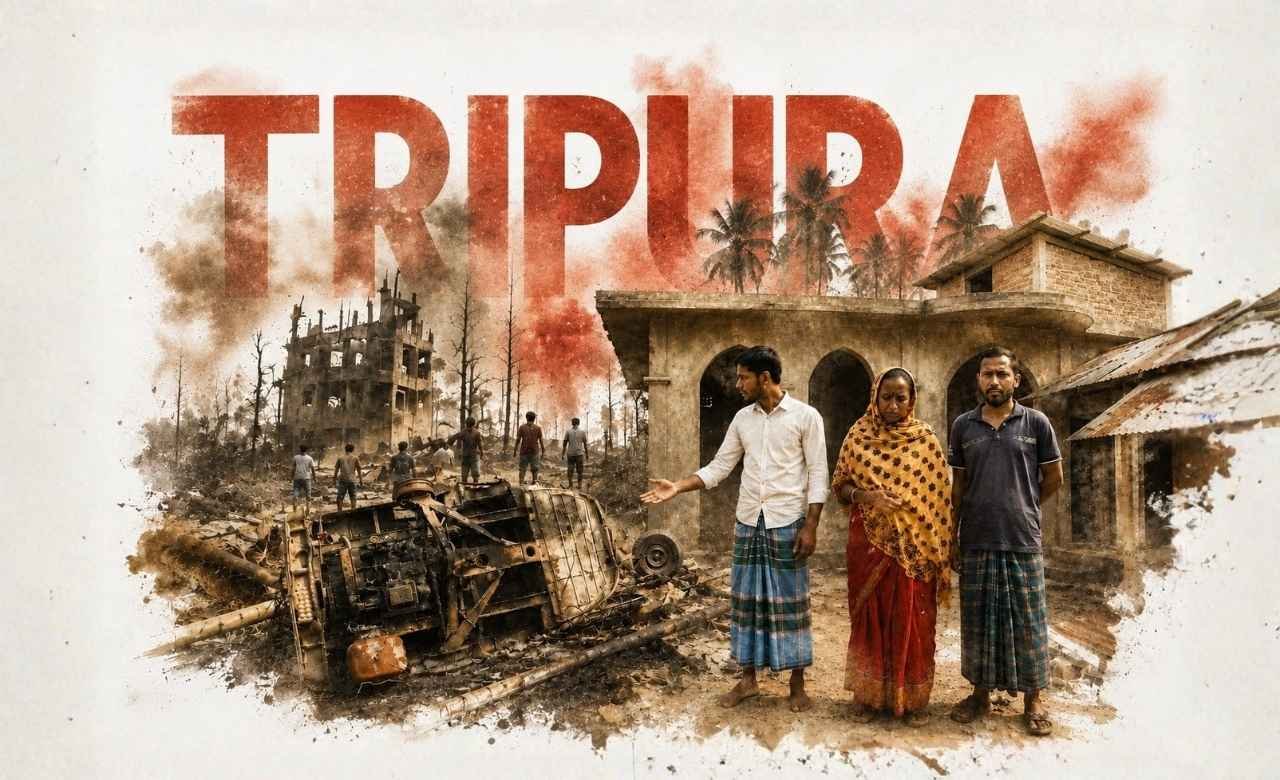
The Communal Violence That Shattered Lives of Underprivileged Muslim Families in Fatikroy’s Tripura
In the early days of the year, on January 10, 2026, communal violence swept through the Saidarpar area under Fatikroy Police Station in the Unakoti district of Tripura, leaving the Muslim community in a state of fear and distress. Muslims homes were vandalised, shops were looted and charred, and the only masjid situated in the area was blackened during the violence. The incident created widespread tension in a region where the Muslim community already lived as a small minority. The immediate trigger of the violence was reportedly linked to an altercation involving a mob collecting “donation” from a Muslim timber-laden truck driver passing through Saidarpar village in Fatikroy. What started as a local dispute soon escalated into targeted violence. Fatikroy is a small town with a population of slightly over 5,000 people. According to the 2011 Census, the Muslim population in the area stands at only 4.39 percent. The community’s small demographic presence had long contributed to a sense of vulnerability and insecurity, which was further intensified by the events of January 10.
The Hardship that Occured:
The violence not only caused extensive damage to property and livelihoods but also resulted in physical injuries. Reports suggest that at least six individuals sustained injuries during the attacks. However, beyond the visible destruction, the incident left behind a deeper sense of fear and uncertainty among the Muslim community. As the community was still grappling with the aftermath of the violence, another blow followed in the form of arrests. As many as ten innocent Muslims were arrested in connection with the incident, adding to the anxiety and distress already prevailing. Meantime, it is imperative to note that a significant section of the affected Muslim population belongs to economically weaker or lower middle-income backgrounds. Their livelihoods are largely dependent on small-scale trade, daily wage labour, and other small activities. For many families, the destruction of shops and household assets was not merely a temporary loss, but a long-term disruption to their economic survival and stability. The impact of the violence, therefore, extended far beyond the immediate days of unrest and lingered to affect the community’s ability to rebuild their lives.
The Relief that Followed:
Upon learning about the incident, Miles2Smile took cognisance of the widespread targeting of innocent residents and the severe erosion of livelihoods in the riot-affected area. The team visited the ground to understand the situation, document the condition of the affected families, and extend relief to those in need. When Miles2Smile went to the riot-ridden houses, the respite and relief clung to the team, showering it whenever required. The team first met the survivors who were injured, then those who lost their livelihoods, and subsequently the families of those who were wrongfully incarcerated. We scrutinized the situation and altered it positively through our relief and rehabilitation work. Through our relief and rehabilitation work we were able to:
Construct Shops
One of the most severe impacts of the January 10, 2026, violence was the destruction of small shops belonging to members of the Muslim community. Several families depended entirely on these shops for their livelihood, with many having no alternative source of income. The loss was not limited to damaged structures alone; it meant the collapse of their daily earnings, financial security, and future stability. Upon visiting the area, Miles2Smile identified the reconstruction of shops and livelihood. The team assessed the extent of the damage and extended support for rebuilding their means of livelihood.
Re-established Business
Among the families affected by the violence were several people whose livelihoods depended on small-scale businesses. It helped them manage daily expenses, children’s education, and household needs. However, during the violence, business-related resources suffered severe damage, leaving families without any immediate means of sustenance. Miles2SMile assisted them in purchasing livestock, repairing poultry spaces, arranging feed, and restarting small-scale operations that had come to a halt after the violence.
Supporting the families of those who were wrongfully incarcerated
While the sole breadwinners of the families were wrongfully incarcerated, their absence filled the house with extreme financial constraints. Daily expenses were mounting while the source of income remained closed. Miles2Smile, through the initiative, helped the families to meet the daily expenses.
The Dastagir initiative by Miles2Smile supports the families of people who have been wrongfully incarcerated. In many of these cases, the imprisoned person is the sole breadwinner, and their absence leaves the family struggling to meet daily needs. Through this initiative, Miles2Smile provides educational support for children, livelihood assistance, and a monthly allowance to help families manage basic expenses. The aim is to ensure that these households can continue their lives with stability while their loved ones remain in prison.
The table shows our relief work in numbers in Jammu & Kashmir forUnder-resourced families.
Smile Hours | Miles Covered | Smiles Restored |
144 | 2871.98 | 47 Individuals, 11 Families |